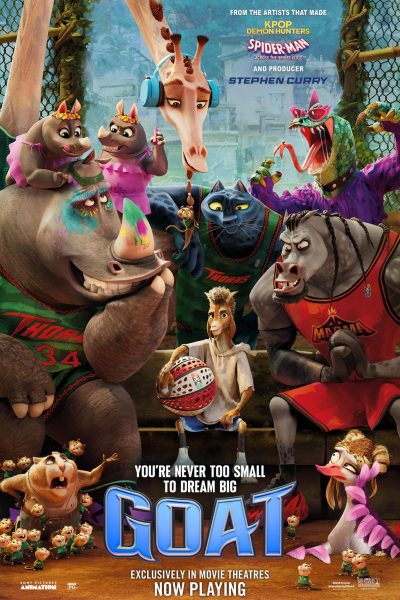
He shoots, he scores, and the crowd goes:
“Baaaa!”
The phrase ‘The GOAT’ has taken on a literal form as the creators of K-Pop Demon Hunters and into the Spider-Verse, Columbia Pictures and Sony Pictures Animation, present their new animated sports comedy movie, GOAT, to theaters.
With Stephen Curry as a producer and star voice actors such as Caleb McLaughlin, Jennifer Hudson, David Harbour and Gabrielle Union driving the story, viewers would likely plop down in their movie theatre seats with high expectations and a stupid grin on their faces — at least I did.
But does the movie live up to the hype?
Peak
The movie follows Will Harris, a young goat aspiring to become a RoarBall player for the Vineland Thorns — inspired by the acclaimed black panther athlete Jett Fillmore and motivated by his late mother’s unwavering belief in his ability to go pro and change the game, despite being a ‘small.’
Although the theme “You’re never too small to dream big” has ushered itself into the cliche department, the movie executes it in a fresh, revitalized way.
With trendy humor scenes such as your mom jokes, viral meow song memes, and the use of the word cooked, it sets this lesson into a modern context that is easy to relate to, even for an unserious generation.
The movie introduces individualistic and charming characters that draw you into their world: a social-media-obsessed emu, a girl-dad rhinosorcus, a giraffe rapper, an absolutely geeked komodo dragon and a petty, over-confident horse.
However, the most important character in relation to Will is of course Jett.
Away from the Herd
Defying typical sport gender tropes, the movie has Will looking up to a female basketball player as his idol. The tastefulness of this choice is that the movie simply lets that dynamic exist naturally without forcing it. They trust the viewer to notice the social commentary, or allow it to go unnoticed because that type of admiration should not be alien or unheard of.
Jett — a self-critical control freak, who carries so much passion for the game that it can consume her entirely, is for all the competitors who have, at times, dealt with an unhealthy obsession with winning. Her internal and external conflicts surrounding her self-worth and purpose are fascinating. Feeling her pain is a knee jerk reaction which makes the viewing experience that much more personal.
To add on to the unconventional, a standout of the movie is the fact Will, despite coming from a low income background and being kidded for wanting to play Roarball as a small goat, faces conflicts that never focus on his ability or self confidence.
Rather, he deals with financial obstacles, bigger animals preventing him from practicing, integrating into his new team and teammate disputes. His main struggle is proving his talent to others instead of himself by having to overcome stereotypes. I appreciate this perspective on the underdog because it empowers a figure who symbolizes oppressed and underprivileged people.
Horns and All
The sole complaint, albeit a minor one, is that the development of certain emotions and choices felt rushed. I wanted to learn more about Will’s drive for basketball besides his childhood admiration for Jett Filmore and the Vineland Thorns and his mother’s encouragement. His passion lacked a complex reasoning for me.
Additionally, certain antagonist character motivations felt sudden and confusing due to underhandled characterization, which made some plot turns feel too quick. To be fair, I believe it was intentional to avoid nitty gritty details in favor of the overall story, which works well regardless.
The movie is packed full of upbeat energy and an entertaining sequence of character arcs and discovery, which succeeds in extending beyond the screen and into real life experiences. Overall, the message, characters and social commentary mark this as a must watch movie that is easily enjoyable.
I would definitely recommend this movie; get a hoof on and go watch it!