

7 year old junior Connor Dooley’s favorite part of visiting his grandfather was when he grabbed his guitar and played. As his fingers plucked at the strings and he sang, Dooley would sit in awe at how skilled he was despite being self taught.
When playing, his grandfather was immersed, which Dooley said was “surreal.”
This admiration inspired Dooley to be interested in music and to consider his grandfather a role model. These special moments were rare — limited visits drastically weakened Dooley’s original instinct to look up to him.
“He wasn’t this guy that I just was thinking about all the time,” Dooley said. “Like, ‘I want to be exactly like him.’ It didn’t seem like they wanted to put themselves in my life.”
Change in Tempo
Before music, Dooley played football and baseball starting at age nine because his parents said always needed to be in an activity. Because he followed whatever his friends did, he lacked passion for sports.
“I’m not a sports person. I don’t watch sports, I never have,” Dooely said. “I didn’t enjoy it. I was just there to be there.”
The uninspired practices only magnified the lack of excitement during low-performance days and battering by coaches, so he pivoted.
“My mom was like, ‘All right, we’re not going to do this anymore.’” Dooley said. “Then, one day, I was just like, ‘Hey, I want to try piano.’ That was the spark, I guess. I have no idea where it came from.”
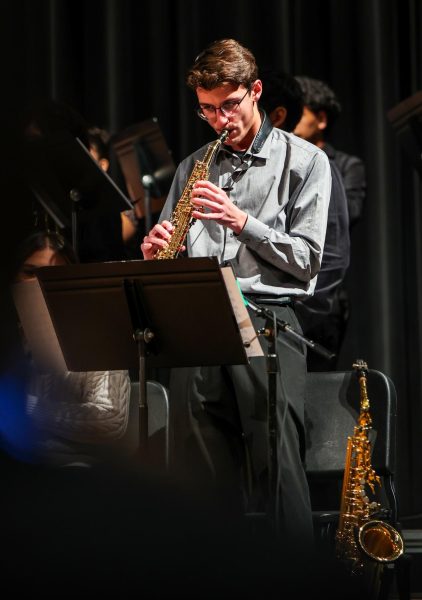
Dooley joined band in sixth grade to play more music. That’s when he decided to learn the saxophone thanks to his love for jazz artist Kenny G. Dooley wanted to be like him.
Dooley says playing the saxophone feels “soul driven” and like “it’s expanding a part of you that maybe you can’t expand in other ways.”
To develop his sound, Dooley studied a variety of saxophone players’ styles — a feat that takes a trained ear.
“It’s maybe not as easy to tell as somebody who probably doesn’t play the instrument because it’s very subtle,” Dooley said. “It’s the same instrument, but there’s big differences.”
Absence
While his love for music grew larger, his fears of entering freshman year shaded his mind.
“Am I going to lose friends? Am I gonna gain friends?” Dooley remembered thinking. “I didn’t want to be like, I guess alone.”
While socializing with high-school band members on 8th Grade Night, Dooley met his best friend, Tristan Laguna, over similar music genres — giving him the companionship he needed to avoid being lonely.
“As soon as I met him in eighth grade, that was like, ‘we’re going to be okay.’” Dooley said. “It was like a safety net.”
Now graduated, Laguna enjoys playing guitar while singing. The pair attend concerts together, last year they saw Dooley’s favorite band Breaking Benjamin and recently saw Stone Temple Pilots in May. Dooley says Laguna understands music probably more than he does.
Despite seeing his friend as an older-brother role model because of his fondness for music, Dooley remains partially unfulfilled.
“I have my parents and they’re great,” Dolley said. “They’re always involved. They care very much. They love me and my brother very much. I’m thankful for that. But to me, that’s a little different than having a specific role model. I don’t really know what I’m looking for in that sense. It’s lonely, I guess.”
In part, Dooley is disconnected from his father, which he speculates may be from a lack of shared interests, which makes him all the more lonely.
“Every day after school leaving the parking lot, I call my mom and we talk about my day, but I’ve never had that kind of relationship with my dad,” Dooley said. “It might be partly my fault because I don’t engage. I have no idea why, but I do wish I had that kind of relationship with him.”
Dooley was happy to hear his mother say his younger brother viewed him as a role model. However, he failed to convince his brother to stay in band, which chipped away at Dooley’s path to connect over music.
“It’s sad,” Dooley said. “I was really looking forward to it because you get to be in the activity that you love with your sibling.”
Dooley became a section leader for band in sophomore year, so this leadership position helped fill the role he felt was missing.
“It’s kind of eye opening because it’s trying to get people to love something as much as you love it,” Dooley said. “There’s a lot of people that don’t have role models in their life. I don’t assume that about people, but it’s just better to be there for people than not to.”
From the top
Dooley also arranges music, changing the instruments and structure to make it something altogether new.
Despite the limited relationship, those arrangements anchor the few visits Dooley has with his grandfather. He asks about experimental choices, and usually if his grandpa says to keep something, he does.
“The experience was just wholesome,” Dooley said. “It was special because I felt connected to him through a common love. Afterward I just felt motivated to keep going and doing the same thing (arranging).”
That grandfatherly relationship is frustratingly elusive.
“There’s a lot of people whose grandparents go to every single one of their events or they’re trying to come over and see them any day of the week,” Dooley said. “My grandparents never have done that, really”
A consistent validating musical figure in Dooley’s life is his older private tutor, Bob Price. Price has improved his skills and created a comfortable space for Dooley to express his love for music by learning from his elders.
“Getting to talk to him about just literally anything is very opening,” Dooley said. “Me and him, we play music sometimes (just) for fun and it’s great. It’s a little bit of all the things I’ve gained from mentorship.”
Devotion
Whether he performs casually or in front of large audiences, one of Dooley’s goals is to see the audience with a “stank face.” When the music is so groovy and head-bob worthy, they have no option but to make a face.
“I just want people to feel it, because feeling music is where I find enjoyment,” Dooley said. “I want people to feel that too because it’s awesome.”
As vice president and member of the Music Honor Society, Dooley performs at the junior high and elementary schools during lunches to help them “leave with something that they didn’t have before.”
“For me what that would mean is hopefully giving a spark to these kids, that’s a big thing for me,” Dooley said. “A lot of people don’t end up doing anything because they never had the person to talk to about something they would want to do. I’m going to go and play for these kids, and I’m going to, hopefully, impress them enough for them to feel the same way I did whenever I first started.”
Even with Tri-M being the heart for music lovers, the love is fainter with numerous members because Dooley feels many people fail to complete service hours or are just in it to be in it. This is yet another attempt to connect through music with what he sees as an unwilling crowd.
“It does feel very insignificant,” Dooley said. “Being that I do love music, it’s like ‘where’s our love?’”
In all, Dooley’s ever growing love for music keeps him wanting to continue it to see how far he can grow in his interest.
“There’s so many levels to it and like how far you can go, so I noticed that and was like ‘How far can I go in this,’ I love it so much,” Dooley said. “I might as well put effort into it.”
Dooley briefly considered future jobs based on the potential for financial stability, but he snapped out of it. Did he really value his enthusiasm for music over money?
“I was tired of trying to decide what career I wanted to slave away at for the rest of my life just for some money,” Dooley said. “I thought about it a lot and I was like ‘music majors don’t really make that much money but they love it, and every single one I know they love it’, so I decided I’m just going to do what I love with my life.”
The “x factor” Dooley was seeking in a role model remains unknown to him and undelivered. Above all, he believes the feeling isn’t necessarily negative.
“Part of feeling that way probably, and honestly, came with wanting validation,” Dooley said. “I think it makes me focus more on what I like and find fulfilling rather than wanting to impress others. If anything it just gives me an advantage in my “success timeline” to move at my own pace and do what makes me happy.”