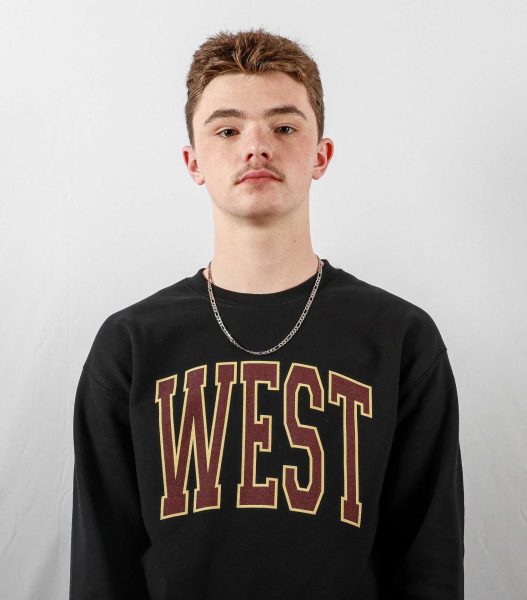
Players line up out of bounds of the basketball gym with their hands on knees, awaiting the whistle from Head Coach Mark Kovach to do their daily suicides; a series of progressively longer sprints followed by short, rapid changes; Their daily goal is to complete two within 31 seconds.
As they repeatedly fail to make it, frustration seeps into the players one by one, shouting “There’s the locker room!”or “Y’all don’t really wanna work!,” their voices a mix of determination and fatigue.
Hopes High, Outcomes Low
Last year’s Basketball team can be defined plainly as unlucky. In a max of bad luck, injuries, and carelessness, the team ended with a district record of 0-16. Losing starting guard Raymond Eubanks for the season after a torn ACL, along with Ivan Martinez missing games from day-to-day injuries helped shape 2024-2025’s missed opportunity after a previous year of positive development. Where they had seemed to shed the “easy win” label — rarely the best team in the district but not just a roll over night in and night out. With a new roster this year, players hope to revive that label and have the potential to exceed it this season.
Tough Start
After being 0-16 last year against district opponents, Caney Creek opened their schedule playing against Willis High School, followed by a gauntlet of district powerhouses like, College Park, Grand Oaks, and The Woodlands high school, all teams who were top three last year in district wins.
Youth Movement
At practice, the program splits into two groups of the varsity team and the junior varsity team program split off , going to the other side of the court, with newcomer Coach Oliphant, a former coach and player at Trinity High School.
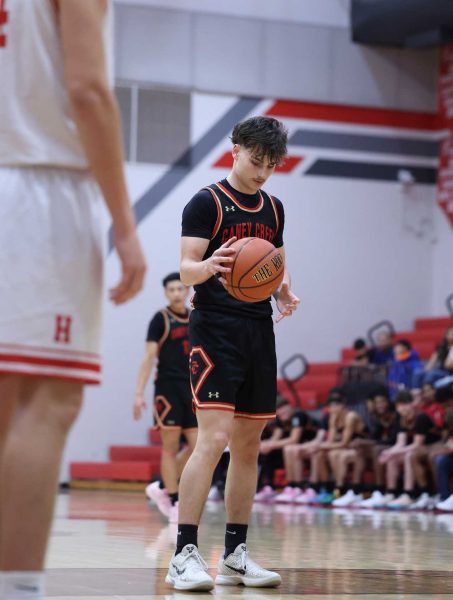
As the practice kept going, the biggest difference compared to previous varsity rosters is the overall youth within the roster. This was teased around the same time that Kovach abandoned their motion offense, wanting to choose to develop more younger players than having to rely on upperclassmen for the teams’ wins, night in and night out. Players such as Austin Perry, Rayden Perroni, Justin Barnes, and Jaiden Marzell; three sophomores, with Perroni a junior and two year varsity player; are seen as the key players of this shift in ideology. Where instead of the focus on the upperclassmen, and the offense that fits with whatever works with them, they find a middle ground of succeeding with the older players, while using that time to develop the players who will take over the program in the future.
New Motions
Prior to the previous season, Kovach had drilled a motion-inspired offense; a free-flowing offensive strategy emphasizing player movement, spacing, passing, and screening to create scoring opportunities, opposed set plays; but halfway through the previous season, he changed tactics after a period of unsuccessful play against district opponents, and the season ending loss of guard Raymond Eubanks due to a torn ACL made him leave that style of play.
“Once Raymond got hurt, our ability to make plays diminished,” said Coach Mark Kovach, head of the Caney Creek Basketball Program. “We lacked a player who could get to the paint consistently and make plays, so we had to pivot to a more structured offense in order to create scoring opportunities.”
The crop of new varsity players makes this offense viable, whereas years before where the main rotation consisted mostly of seniors. This season provides opportunity to implement this system without complete overhaul of what these players are used to.
Kovach added that bringing back this system is because of more playmaking ability within this roster, compared to last year where the playmaking was depleted due to injuries.
“Having playmakers enables a more free flowing offense, once that’s removed, you have to be structured in order to be competitive,” Kovach said.
Always Us
This ethos on togetherness and everyone involved is reflected in the daily routine throughout practice.
As days inch closer, and closer to the opening game, there’s a difference in the priority of the team moving toward not just the success of the individual and program, but everything revolving around the five people on the court.
Watching practices, everything from them yelling numbers one through twenty as they stretch before practice officially begins, to their chant that they end practice with every day, “Sometimes you, sometimes me, always us.”